
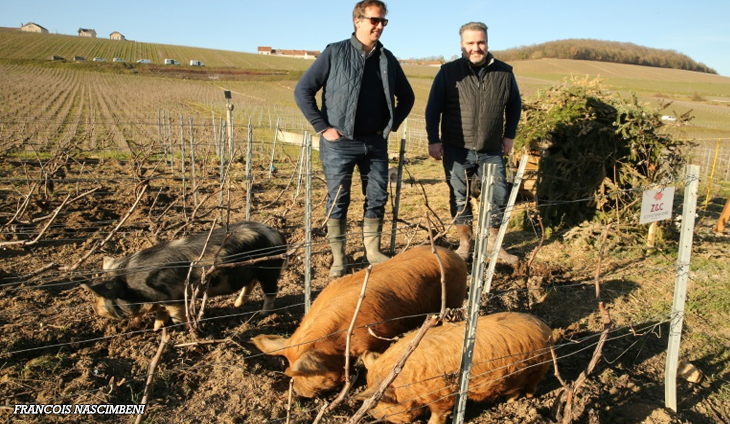
Villagers in Cramant in France’s Champagne are being treated to a rare sight: little pigs grubbing around the vines that produce the region’s famed bubbly, an alternative to chemical or mechanical means of fighting weeds and pests.
Originally from New Zealand, the “kunekune” pigs — a Maori word meaning “round and fat” — snuffle through the earth supporting neatly planted rows of grapevines.
Their “thorough” and “precise” work can fight weeds as well as mildew and other fungi and aerate the soil, says wine industry consultant Olivier Zebic.
First tested last year in the Bordeaux wine-growing region, the pigs may be a better choice than the other eco-friendly solution, sheep — who “just trim” unwanted plants, Zebic adds.
By contrast, the kunekune turn over “every clod of grass and even eat the roots… stopping new growth,” he says.
Weighing around 40 kilos (88 pounds) each, the pigs avoid eating valuable earthworms and cannot lift their heads high enough to attack the vines’ leaves and branches.
What’s more, “they gobble up living leaves that fall to the ground straight away”, preventing fungi from taking hold.
The pigs allow a “very significant” reduction in use of chemical treatments, Zebic says.
Jean-Etienne Bonnaire, a champagne grower hosting the experiment on his 22 hectares, says you “can’t revolutionise everything with pigs” but they “complement” the vineyard’s transition to organic methods.
His herbicide-free plot had previously been weeded with diesel-fuelled machines that tamped down the earth and risked damaging plants.
The kunekune are “an extra tool for difficult plots”, Bonnaire says, such as “on the slopes where we lose four or five centimetres (two inches) of soil per year with the storms”.
Contained with an electric fence and watched over by surveillance cameras, the pigs are a “rather astonishing” sight on a Chardonnay plot, says Maxime Toubart, president of the Union of Champagne Winegrowers.
“It’s always interesting to experiment,” he adds, while wondering “if this can be replicated on a large scale”.
Zebic suggests that the pigs could in future be herded from one vineyard to another to do their vital work.
The kunekune could yet form a vital building block for the regional champagne industry body’s aim of certifying 100 percent of growers as eco-friendly by 2030. — Agence France-Presse


